
Trends are like pendulums, they either swing away from the trend that came before them, or continue further along the same continuum whilst elevating the appeal.
Here's what The Block judge Darren Palmer has to say about how to incorporate trends into your kitchen design and which appliances you should consider to ensure your kitchen is up to date.
Colour - How To Create The Perfect Palette
-638283531579466657.jpg)
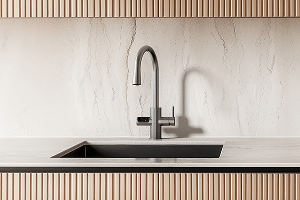
There was a time when white kitchens were ubiquitous, then a trend in kitchens followed for anything but white. Well, the pendulum has swung back in the direction of white kitchens, albeit this time with the addition of statement handles that act like jewellery to elevate the appeal of this otherwise simple palette.
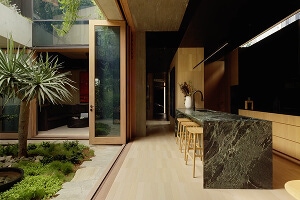
Just as handles add appeal, so too do coloured natural stone benchtops, either as bench and splashbacks, or as full island benches. Colour names vary from importer to importer but think dark plums with white veins, mixed and varied versions of pinks or creams. Greens, golds and even blues mixed with greys also create a sharp visual appeal. If you’re thinking on-trend stone think anything but white and grey.
Coloured panels also have a place in current and on-trend kitchens. Deep greens are always a crowd pleaser though it’s wise to choose a colour that works across your home and with a view to longevity of appeal.
-638283541079410419.jpg)
Profile doors have a place, as to do flat panels. There’s no right or wrong here though we have seen many types and styles of profile doors so there is a trend tending towards the simpler flat panels, though these are often coloured, timber, or timber-look laminate. When it comes to timber, oak is a perennial option though there’s also space for chocolate and walnut tones. Greyed timber also have a place though red timbers haven’t quite come back around yet.
Function - Considering How Your Space Is Used
-638283561299881091.jpg)
Aside from colours and materials there has definitely been a trend toward butler’s pantries over the past decade though this is likely to be turning tail in favour of larger island benches and fully functional, stand alone kitchens. Butler’s pantries are a luxury inclusion to be sure, but they’re also a space taker and one to keep for large footprints in large houses.
The 5-Zone Approach
Zone 1: Cooking
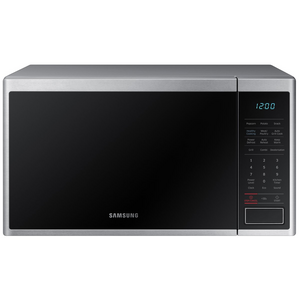
This includes appliances such as oven, microwaves, steam ovens, and cooktops. Warming drawers and secondary appliances can be included within the cooking zone’s vicinity.-638283581425656043.jpg)
-638284377260903638.jpg) Smeg Dolce Stil Novo Pyro Steam Oven
Smeg Dolce Stil Novo Pyro Steam OvenView Here
 Smeg Dolce Stil Novo Warming Drawer
View Here
-638283579998658387.jpg) BORA X Pure Induction Cooktop
BORA X Pure Induction CooktopView Here
-638284378146290821.jpg) Smeg Dolce Stil Novo Omnichef Combi-Microwave Oven
Smeg Dolce Stil Novo Omnichef Combi-Microwave OvenView Here
Zone 2: Cleaning
The ideal layout is having the bin next to sink or next to dishwasher. But a bin within one step away is an acceptable compromise. Also, a cleaning zone needs to be within one to two steps of a non-consumables zone.-638283587357000989.jpg)
-638283587925984687.jpg) The Galley Ideal Work & Wash Station
The Galley Ideal Work & Wash StationView Here
-638283588615914169.jpg) The Galley The Ideal Worksation
The Galley The Ideal WorksationView Here
-638283589226398931.jpg) The Galley Ideal Eco Flow Mixer Tap
The Galley Ideal Eco Flow Mixer TapView Here
-638284368936372077.jpg) V-ZUG AdoraDish V6000 Fully Integrated Dishwasher
V-ZUG AdoraDish V6000 Fully Integrated DishwasherView Here
Zone 3: Non-Consumables
Plates, glasses, cups, cutlery, plasticware and cookware all fall within the non-consumables zone. These are things you use in your kitchen on an everyday basis so they should be easy to access and easy to load from the dishwasher or sink.-638283594748687747.jpg)
Serax Surface tableware collection by Sergio Herman
-638283597226161541.jpg) Serax Surface Large Bowl - Indi Grey
Serax Surface Large Bowl - Indi GreyView Here
-638283598467997518.jpg) Serax Surface Large Deep Plate
Serax Surface Large Deep PlateView Here
-638283599581568792.jpg) Serax Surface Cappuccino Cup & Saucer
Serax Surface Cappuccino Cup & SaucerView Here
-638283600149711453.jpg) Serax Surface Tapas Plate
Serax Surface Tapas PlateView Here
Zone 4: Consumables
Consumables are what you eat. Your fridge is a consumables zone and needs a bench nearby to load your grocery from and into the refrigerator. Your pantry is another consumables zone and equally needs to be near a benchtop. Ideally both cold and non-refrigerated food can be loaded from the same adjacent benchtop.-638283611054395737.jpg)
-638283611846369320.jpg) Fhiaba Classic 427L Fridge with Trimode
Fhiaba Classic 427L Fridge with TrimodeView Here
-638283612393878227.jpg) Liebherr 665L Pigeon Pair Fridge
Liebherr 665L Pigeon Pair FridgeView Here
-638283613317552533.jpg) Fhiaba 494L Integrated Fridge
Fhiaba 494L Integrated FridgeView Here
-638283614221032783.jpg) Fhiaba 478L Integrated Freezer
Fhiaba 478L Integrated FreezerView Here
Zone 5: Preparation Space
Just another term for bench space. Useful for preparing food but also for spreading out on either side of a cooktop, as well as loading groceries, space where kids can do their homework, dining, or as additional work-from-home space.-638283616442974028.jpg)
Feeling Inspired?
Book a meeting with a Product Expert and discover how you can turn your dream kitchen into a reality