
This is a buying guide to the de have available – helping you determine the ideal model that suits your budget, taste and technical requirements. You’ll find three different types of dryer at Winning Appliances: vented, condenser and heat pump.
Vented Dryers | Condenser Dryers | Heat-Pump Dyers | |
|---|---|---|---|
| Cost | Very affordable $ | Affordable $$ | Most long-term savings $$$ |
| Ventilation | Requires good ventilation | Minimal ventilation required | No ventilation required |
| Efficiency | Good efficiency | Excellent efficiency | Best efficiency of all options |
| Clothes care | Can cause shrinking of some fabrics | Excellent clothes care | Best clothes care |
| Wall Mountable | Yes (Lightweight) | No | No |
| Stackable | Depending on size | Depending on size | Depending on size |
| Our Best Seller | 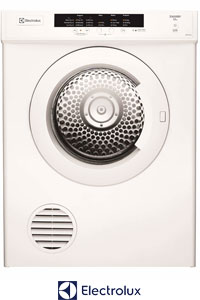 Electrolux 6.5kg Vented Dryer EDV6552 | 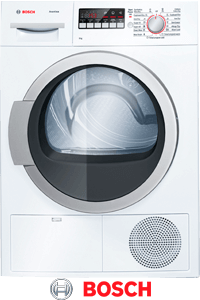 Bosch Serie 4 8kg Condenser Dryer WTB86200AU | 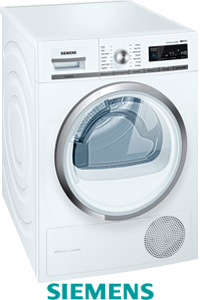 Siemens iQ800 9kg Heat Pump Dryer WT47Y7W0AU |
Vented Dryers
Vented dryers are the simplest and most common of all drying technologies. Cheap to buy, these dryers basically work by blowing heat through your clothes, producing moist air which is typically vented through the front of the appliance. As a result, they work best in a spot with good ventilation – or somewhere you can easily install a duct out the nearest window.
Advantages/Disadvantages
Very affordable and popular, they are also light enough to be wall-hung or stacked on top of a washing machine, which can be helpful in a laundry short on space. However, of all the dryer varieties, they are generally the least efficient to run and have the smallest capacities: two factors which will make them the most expensive to run in the long-term. Having said that, the best examples feature innovations that greatly improve their capabilities and boast excellent economy - with technologies such as sensor drying leading to brilliantly gentle and effective results.
Just remember
that unless you can effectively ventilate the moist air it will produce, you risk unwillingly turning your laundry into a steam-room. If you want to avoid condensation dripping down the walls, at least ensure you can open a nearby window - or have a venting/ducting kit (available for some machines) installed.
Clothes care
Vented Dryers use 'elemental' drying, so can cause shrinking of some fabrics like woollens and deterioration of the fibres of some materials from the lack of temperature control of the heat.
Excellent stand-by solution
With all those factors in mind, they are best used as a standby when it’s too rainy for line-drying or when you need that favourite item ready in a hurry. At Winning Appliances we have a selection of excellent vented dryers that perform this job to the highest standards offered by this technology.
Choose from our range of vented dryers
Condenser Dryers
Whereas vented dryers simply expel the hot moist exhaust air, these machines condense the water from the air to be drained away via plumbing or collected in a reservoir. There will be some exhaust air but it will be much less damp - it is likely to make an poorly ventilated room warmer but will not leave condensation running down the walls.
Advantages/Disadvantages
With these models, you’re looking at larger capacities – generally rated between 6 and a half and 10 kilograms. These are heavy-duty performers, as opposed to the more lightweight vented dryers. This means that not only are they able to handle larger washing loads but they’ll be much more quiet.
Their disadvantage in this respect is that they will be more expensive relative to vented dryers and that, due to their weight, they can be inappropriate for stacking.
Long-term savings
As a general rule, the initial cost of a Vented Dryer will be greater - these machines will also often take longer to run through a cycle. However, in the long term the power savings are considerable: often around 30%. What’s more, with no ventilation required, they are ideal for laundries without windows – or for non-traditional applications which are becoming increasingly popular, such as cupboards or off-kitchen spaces.
Clothes care
As condenser dryers remove the water from the fabric first and then use more even elemental drying, this means the heat applied to clothes fibres is less intense and more controlled. Meanwhile the gentle tumbling action and static control of the condenser system also reduces linting and extends the life of the clothes.
Remember
The dryer will have to be connected to a drain or you will need to have the water tank emptied frequently.
Choose from our range of Condenser Dryers
Heat-Pump Dyers
These are also a type of condenser dryer, but attain even greater energy efficiency by continuously **recycling** the heat used in the process of extracting moisture from your clothes. While conventional condenser dryers expel the hot air once the moisture has been extracted from it, heat pump technology pushes it back into the drum to keep the cycle going.
The best performers
While they are typically the most expensive variety of dryer – their efficiency ensures the biggest savings in the long run, both for your wallet and the environment. Not only does it conserve energy, the heat exchange system allows lower air temperatures to be used in the drum: which is better for your clothes.
Clothes care
By further controlling heat and converting water from the clothes to dry them in a more natural way, the process takes longer but it is far more gentle: it is comparative to clothes line-drying in a warm breeze.
Remember
To get the best performance of your heat pump dryer, ensure filters and evaporators are clean (select models have self-cleaning capabilities.)